Ankle and Achilles Tightness: 7 Mobility and Stretching Exercises
Ankle range, calf mobility and gentle Achilles-related movement, with a note on suspected injury.

Stiff ankles and tight calves are common, and they can influence how comfortably you squat, walk and run. This guide covers gentle mobility and stretching for general tightness. It is worth separating that from a suspected Achilles injury: sudden sharp pain at the back of the heel, a sensation of being struck there, marked swelling, or difficulty pushing off or standing on tiptoe needs prompt medical assessment, not stretching.
Who this suits
Anyone with everyday ankle stiffness or tight calves. Work slowly and keep the Achilles movements gentle.
Seven movements
- Ankle circles. Circle each ankle in both directions to warm the joint.
- Heel-to-toe rocks. Rock gently from heels to toes to move the ankle through range.
- Knee-to-wall. With toes a short distance from a wall, ease the knee forward over the toes to mobilise the ankle, keeping the heel down. A useful way to track progress over weeks.
- Calf stretch (gastrocnemius). Step one foot back with the knee straight and ease the heel down.
- Soleus stretch. Similar to the calf stretch but with the back knee bent, to reach the deeper calf muscle near the Achilles.
- Calf raises. Rise slowly onto the toes and lower with control to build gentle calf and Achilles capacity.
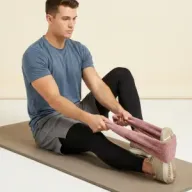
- Toe stretch. Gently stretch the underside of the toes and foot, easing in slowly.

Supported balance
Ankle work is a good moment to include a little balance. Try standing on one foot near a wall or chair, using a fingertip for support and reducing it as you feel steady. Keep it well within your confidence.
Gentle Achilles-related movement
Slow calf raises and the soleus stretch load the Achilles region gently. Keep the effort mild and the range comfortable; the aim is easy, controlled movement rather than a strong stretch.
Easier variations
- Hold a support for knee-to-wall and single-leg balance.
- Do calf raises with both feet before progressing towards one.
- Reduce the range of the toe stretch if the foot is sensitive.
When to stop and seek help
Stop for sharp pain at the back of the heel or ankle, swelling, or difficulty bearing weight. A suspected Achilles injury - especially sudden pain with weakness pushing off - warrants prompt assessment.
Why ankle range matters beyond the ankle
The ankle's ability to bend forward - bringing the knee towards the toes with the heel down - influences how comfortably you squat, walk downhill and absorb impact when running. When that range is limited, other areas such as the knees and hips sometimes compensate. This is why the knee-to-wall movement is worth returning to: it is both a mobiliser and a simple way to track whether your ankle range is improving over weeks.
Loading the Achilles gently
The Achilles tendon responds well to gradual, controlled loading rather than only stretching. Slow calf raises - rising and lowering with control - are a gentle way to build capacity in the calf and tendon. Keep the effort mild to start, and progress the number of repetitions or the range slowly. If you are working around a sensitive Achilles, avoid sudden, springy or high-impact loading and build up patiently.
Telling general stiffness from an injury
General tightness eases as you warm up and does not stop you moving normally. Signs that point towards an injury needing assessment include sudden sharp pain at the back of the heel, a feeling of being kicked or struck there, noticeable swelling, or difficulty rising onto your toes. If those are present, pause the routine and seek advice rather than stretching through it.
Related routines
Guided options include Foot and Ankle Ease, the Springy Achilles routine and an ankle resilience routine.
Sources
Put the guide into practice
Related Flexor routines
These guided routines are linked to the article topic. Review the difficulty and exercise list before starting.