Why Do I Still Feel Stiff Even Though I Stretch Every Day?
Feeling tight is different from measured flexibility. Troubleshoot your stretching goal, effort and wider activity without diagnosing stiffness from a sensation.

You can feel stiff even when you stretch regularly, because the sensation of tightness is not the same as a measured limit in movement. Stretching may change range of motion or feel helpful for a while without removing every reason an area feels uncomfortable.
The next step is not automatically to stretch harder or more often. Check what you are trying to change, whether the routine fits that goal, and how the rest of your activity and recovery look. Persistent, painful or changing symptoms deserve assessment rather than an assumption that a muscle must be “too short”.
Separate the feeling from the movement
Range of motion describes how far a joint moves under particular conditions. You might assess it through a familiar task or a standardised test. Studies may also measure mechanical muscle stiffness: how tissue responds to an applied force. That laboratory property is different from the everyday feeling of stiffness. Neither a range measurement nor a mechanical-stiffness finding identifies why you feel tight.
For example, someone may reach the same shelf easily but feel stiff after a long workday. Someone else may have a particular movement limit without a strong sensation of tightness. Neither example identifies a diagnosis. Sensations alone cannot establish weakness, shortened muscles, nerve problems or inflammation.
This distinction matters because it changes what success looks like. If your goal is to reach a cupboard comfortably, repeating that task under similar conditions may tell you more than asking whether the area ever feels tight. If the main problem is pain, a generic flexibility target may not answer the question at all.
What regular stretching can change
A 2024 systematic review and meta-analysis of stretch and foam-rolling training found improvements in measured range of motion with training compared with controls. The studies varied, so an average result does not predict a particular person's outcome or timeline.
A 2025 expert consensus on stretching exercise also supports a role for acute and repeated stretching in improving range of motion. It puts limits on broader claims: stretching is not an all-purpose injury-prevention strategy, a substantial muscle-building programme or a universal treatment for acute recovery.
These sources address measured range and exercise recommendations. They do not show that daily stretching resolves every experience of stiffness, validate a particular app routine for a medical condition or establish a precise prescription for your symptoms.
Why a helpful session may not feel permanent
An immediate response and a lasting training change are different outcomes. A position may feel easier just after practice, yet feel less comfortable later in the day. That does not necessarily mean the practice was useless. It may mean that the sensation you hoped to change is influenced by more than the range you worked on.
Equally, temporary relief is not a diagnosis. You cannot conclude that an area was shortened because a stretch felt good, or that inflammation was removed because a movement felt freer afterwards. Observe the response without attaching an unsupported explanation to it.
Our guide to daily stretching discusses the broader habit. The question here is more specific: when a habit already exists, does its purpose match the problem you are trying to solve?
Check the goal, selection and effort
Choose one everyday movement that matters to you. Perhaps it is turning comfortably to look behind you, reaching overhead or using a position required for a hobby. You do not need maximum flexibility in every direction. A meaningful goal helps you decide whether the selected movements are relevant.
Then consider the routine itself. Are you repeatedly working on an area because it feels familiar, while the task involves a different movement? Can you enter and leave the positions comfortably? Does the session feel manageable, or have you been escalating tension because progress seems slow?
A stronger stretch is not automatically a better stretch. Avoid forcing through pain, bouncing to reach a target or treating discomfort as proof of effectiveness. If a position leaves an area irritated, reduce or stop it and consider whether advice is needed. This article cannot decide the right exercise or dosage for a painful condition.
Look beyond the stretching session
Your day may include long periods in one position, demanding training, poor sleep or limited recovery. Those details can be relevant to how you feel, but they should not be used to diagnose the cause from a distance. A stretching session cannot be expected to erase the whole day's experience.
Walking and other comfortable activity offer different movement opportunities. Strengthening can also be part of a broader programme for physical capacity. That does not mean stiffness proves you are weak; it means flexibility is only one component worth considering. Our comparison of stretching and strength training explains why neither should be treated as a universal replacement for the other.
If scheduling is the problem, see the stretching-frequency guide. If you are already stretching daily, adding more sessions may be less useful than clarifying the goal or obtaining advice about a persistent symptom.

Use one everyday task as your comparison
Suppose your goal is to reach a familiar shelf comfortably. Notice how that task feels at an ordinary moment, without forcing the reach. Choose a gentle familiar movement relevant to reaching, using a range that stays comfortable. Do not stretch harder to make the comparison more dramatic.
On a later comparable occasion, try the same shelf again. Ask whether reaching feels more manageable, the same or worse. Similar task and conditions make the observation more useful, but they cannot diagnose a tissue change. If reaching is painful, choose an easier task or stop; persistent or worsening symptoms call for assessment rather than repeated testing.
You might discover that function is unchanged despite feeling looser after a session, or that a task becomes easier even though some tightness remains. Both observations help clarify the goal. If nothing useful is changing, reconsider the approach instead of extending the routine indefinitely. The research does not provide a guaranteed deadline for your result.
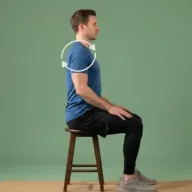
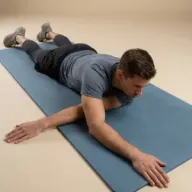
For the reaching example above, preview Flexor's Quick Shoulder Unlock. Its beginner sequence focuses on shoulders and chest, with wall and doorway work plus a floor-based shoulder stretch. Check each position against your comfort and available space before saving it to Favourites. The focus is more relevant to an overhead-reaching goal than repeating an unrelated full-body sequence. Stop a movement that causes pain; the app cannot explain the cause of stiffness or replace an assessment.
When stiffness needs assessment
Ask for professional advice if stiffness is persistent, worsening, painful or interfering with everyday tasks. New swelling, marked changes in movement, numbness or weakness should not be explained away as ordinary tightness. Sudden or severe symptoms may need more urgent care.
A physiotherapist or other appropriate clinician can assess the actual movement and symptom pattern. That is different from assigning a diagnosis because an internet description sounds familiar. If you already have a joint condition or injury plan, use that guidance when choosing exercise.
Follow-up questions
Does feeling tight mean I need more flexibility?
Not necessarily. First consider whether the movement you need is actually limited. A sensation alone does not show a range deficit or identify which activity would help.
Should every session feel like progress?
No. The sources support changes in range with training on average, not a steadily improving feeling every day. Look at relevant function over time and avoid making the session harder just to create a stronger sensation.
Can I stop a stretch that keeps irritating me?
Yes. There is no need to keep repeating a painful position to preserve a streak. Reduce or stop the provoking movement and seek advice if symptoms persist or concern you.
Is strength training the missing answer?
It may be relevant to a balanced activity plan, but stiffness does not prove a strength problem. Choose strengthening for an appropriate goal and seek individual guidance if you are unsure how symptoms affect exercise selection.
For a consistent sequence you can follow comfortably, download Flexor and choose a routine suited to your goal. Use the guidance to organise practice, and seek individual advice when stiffness persists or changes.
Sources
- Practical recommendations on stretching exercise: expert Delphi consensus — range of motion and boundaries of stretching claims.
- Static stretching versus foam rolling training: systematic review and meta-analysis — measured range outcomes, not diagnosis of subjective stiffness.
Put the guide into practice
Related Flexor routines
These guided routines are linked to the article topic. Review the difficulty and exercise list before starting.