
What Happens If You Stretch Every Day? What the Research Shows
What changes after one session, after several weeks, and whether daily stretching is actually necessary for flexibility gains.

Stretch every day and you will probably become more flexible — but the research does not say that seven days a week is required, that more stretching always produces more benefit, or that daily stretching automatically fixes pain, posture or recovery.
The useful question is not “is daily stretching good?” in isolation. It is: what adaptations happen after one session, what changes after weeks of repetition, and how much practice appears to be enough?
The most important caveat: “daily” has not been proved superior
Most stretching research is not designed as a clean comparison of seven days per week versus three or four. In the large 2025 meta-regression, weekly session frequency did not significantly moderate long-term flexibility gains once the wider training dose was considered. That means the evidence supports regular exposure, not a special biological effect from ticking off every calendar day.
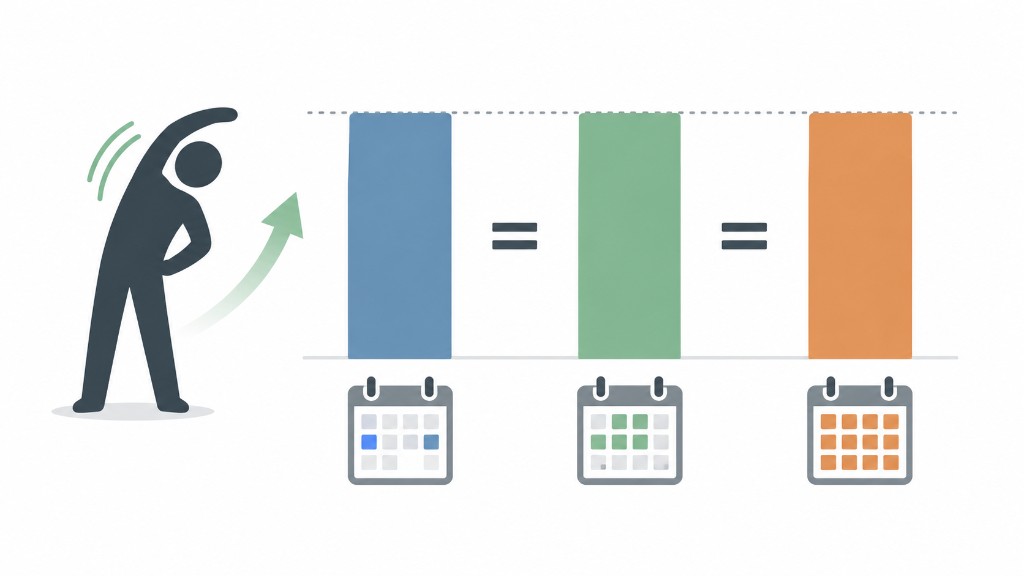
Daily practice can still be valuable because habits are easier to remember when they are attached to a routine. But that is a behavioural advantage, not proof that seven sessions produce better flexibility than a well-designed lower-frequency programme.
The short answer
- A single session can temporarily increase range of motion.
- Repeated stretching over weeks can produce larger, longer-term flexibility gains.
- People who begin less flexible often improve more.
- Higher weekly frequency does not appear to guarantee larger gains once overall stretching exposure is considered.
- Daily stretching is therefore an option for habit and comfort, not a scientific requirement.
After one session: range of motion usually increases
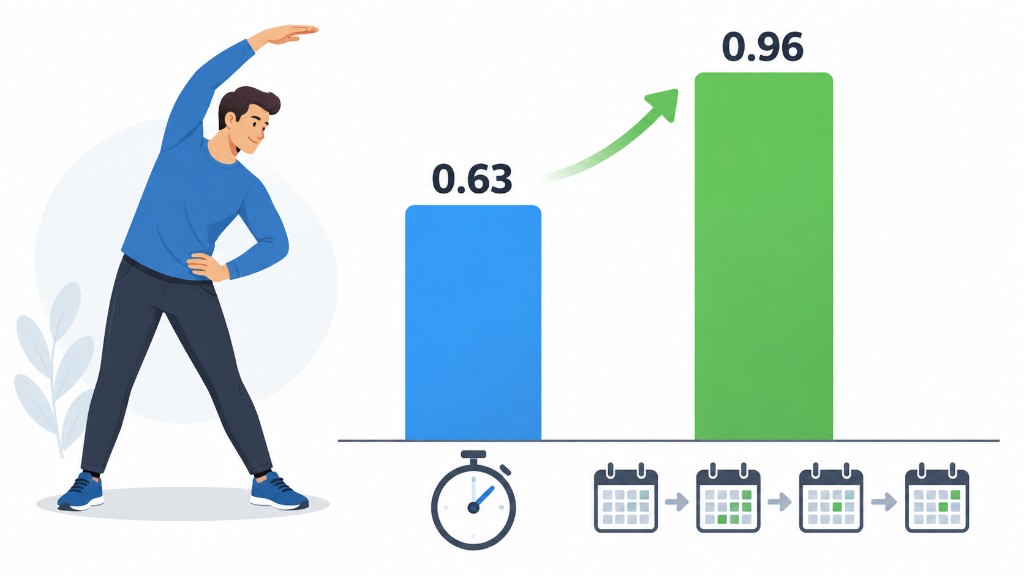
Across 189 studies, the pooled acute effect of static stretching on flexibility was Hedges' g 0.63, a moderate standardized effect. That compares studies which used different tests. It is not a universal number of centimetres or degrees.
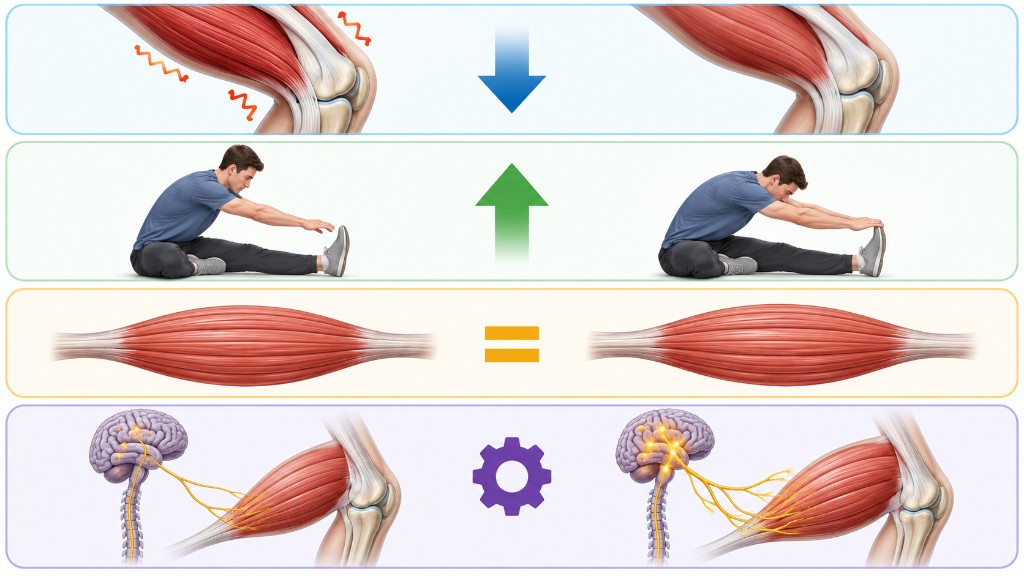
That immediate change does not mean the muscle permanently becomes longer during the session. A separate 2025 mechanisms review found that acute static stretching can reduce passive stiffness. Stretching also changes how much tension a person is comfortable tolerating near the end of range.
This helps explain the familiar experience of feeling “looser” straight after stretching. Some of the change is mechanical, some is sensory, and the immediate effect is not the same thing as long-term training adaptation.
After weeks: repeated stretching produces larger flexibility gains
In the same 189-study analysis, chronic stretching programmes produced a larger pooled effect on flexibility than a single session: Hedges’ g 0.96. Another meta-analysis of 77 studies also found a substantial overall improvement in range of motion from chronic stretch training.
The word chronic in exercise research simply means repeated training over time. It does not mean chronic pain. Programmes vary, but the evidence base includes interventions lasting multiple weeks rather than one-off sessions.
Does doing it every day work better?
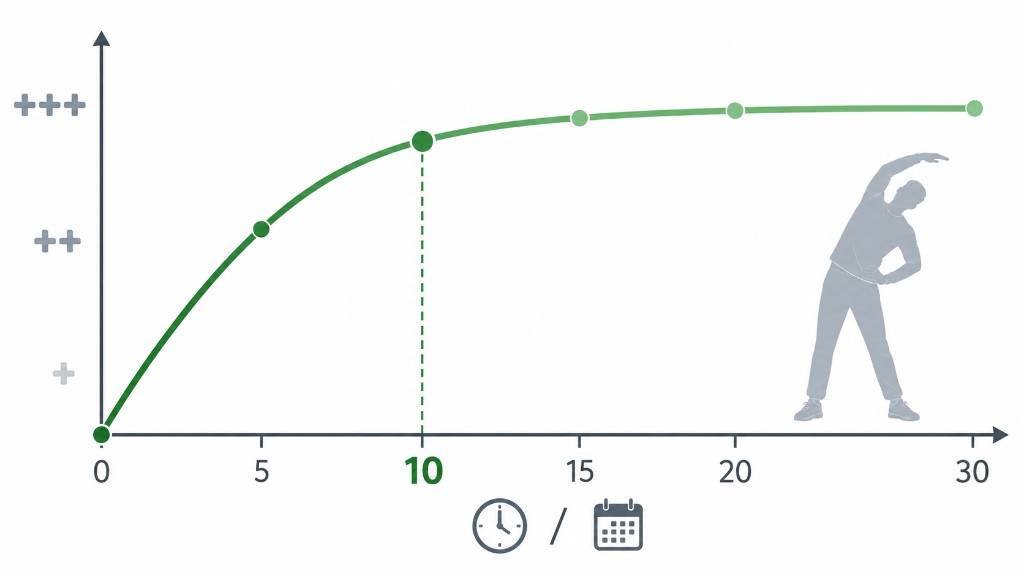
Not by adding more minutes. The same analysis found no further flexibility benefit beyond about 10 cumulative minutes of static stretching per week.
That is not a rule that everyone should do exactly ten minutes. It means that within the available research, piling on more total static-stretching volume did not continue to increase the pooled flexibility effect.
For a normal person, this is good news. You can choose a schedule that is easy to maintain: a little most days, several focused sessions each week, or mobility woven around training.
What people actually report doing
The activity-frequency data often cited here come from a US NHANES analysis using surveys collected in 2003–2006. Participants who reported stretching averaged 4.61 sessions per week. It is a useful historical description of behaviour, not a current global benchmark and not evidence that 4.61 sessions is an optimal dose.
An analysis of U.S. NHANES data from 2003–2006 provides an interesting real-world snapshot. Among adults who reported stretching, the average session lasted 16.5 minutes and occurred 4.61 times per week. That was more frequent than the average reported sessions for walking, weight lifting, treadmill exercise or aerobics among people reporting each activity.
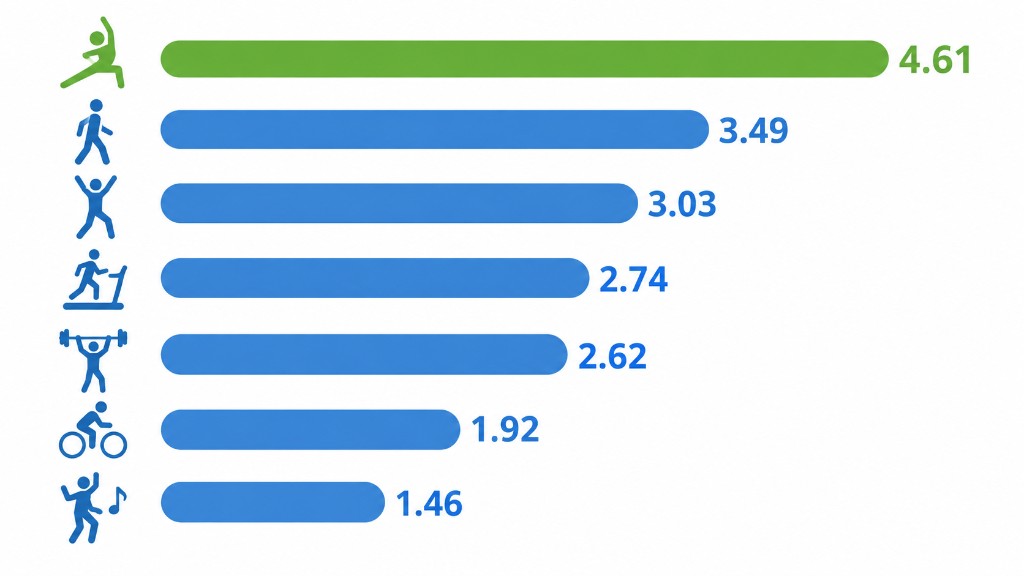
Those numbers do not show that stretching 4.61 times a week is optimal. They simply show that stretching can fit naturally into a frequent, relatively short activity pattern.
What changes first: tolerance, stiffness or muscle structure?
A systematic review of 65 studies gives a useful mechanistic picture. Static stretching produced small reductions in overall passive stiffness after both acute and chronic interventions. Chronic stretching also increased maximum tolerable passive resistive torque — essentially, participants were able to tolerate more passive tension at the end of range.
The same review did not find a significant overall effect on muscle fascicle length. So the everyday phrase “stretching lengthens your muscles” is too simple. Flexibility gains can occur because the muscle-tendon unit behaves differently and because the nervous system becomes more tolerant of the stretched position, even without a measurable increase in fascicle length.
If you start tight, you may have more room to improve
The 189-study meta-analysis found larger flexibility improvements among adults who began with poorer baseline flexibility than among people starting around average. That makes intuitive sense: someone already near the upper end of their available range has less room to make dramatic gains.
It also means progress should be judged against your own baseline. Comparing your forward fold to someone with years of dance, gymnastics or mobility training is usually less useful than asking whether your own range and control are improving.
Can daily stretching change everyday function?
Flexibility measurements are not the same as daily life. The most interesting evidence therefore looks beyond joint angles.
In a longitudinal cohort of 1,318 adults, people who reported stretching were associated with 24% lower odds of developing functional limitation over follow-up. Because the study was observational, it cannot prove stretching was the cause. The cohort was also predominantly white and male, which limits how confidently the finding can be generalized.
Randomized and controlled workplace studies provide additional context. A three-month programme of 10-minute post-work stretching found improvements in flexibility as well as several pain and well-being measures. Another 12-week office-worker programme using roughly 10 minutes twice weekly reported improvements in multiple quality-of-life domains.
Together these studies suggest that regular stretching can matter outside a flexibility test, but the evidence is not strong enough to promise that a daily routine will prevent future disability.
What daily stretching will not automatically do
Regular stretching is sometimes treated as a universal health habit. The evidence is more specific.
- It does not reliably prevent DOMS. Stretching before or after exercise produces little meaningful reduction in post-exercise soreness on average.
- It has not been shown to prevent all sports injuries by itself. Injury prevention is better thought of as a combination of appropriate training load, strength, skill, conditioning and task-specific preparation.
- It does not guarantee “perfect posture”. Posture varies naturally, and strengthening and behavioural changes may be more relevant than passive range alone.
- It is not a treatment for every painful condition. If a movement repeatedly aggravates symptoms, more range may not be the answer.
A sensible seven-day approach
| If your priority is… | A sensible pattern | Why |
|---|---|---|
| General stiffness | Short, comfortable mobility on most days | Keeps movement distributed through the week without requiring hard sessions |
| Improving one restricted range | Focused stretching several times per week, with enough cumulative volume | Targets the actual movement you want to change |
| Sports preparation | Use dynamic movement and sport-specific warm-up; place longer static work elsewhere if performance matters immediately | Warm-up and flexibility training are related but different goals |
| Recovery day | Gentle movement if it feels good; rest if symptoms are aggravated | Stretching is optional for recovery, not a requirement |
If you enjoy stretching daily, keep the sessions varied rather than chasing the same end range every day.
| Day | Example emphasis | Why |
|---|---|---|
| Monday | Full-body mobility | Move through several joints without long holds |
| Tuesday | Hips and hamstrings | Focused static flexibility work |
| Wednesday | Desk movement breaks | Break up sitting rather than adding another workout |
| Thursday | Shoulders and upper back | Balance the week across body regions |
| Friday | Mobility and control | Use active range rather than only passive holds |
| Saturday | Longer relaxed session | Optional deeper flexibility work |
| Sunday | Easy movement or rest | No need to force a streak |
Flexor routines such as Full-Body Flexibility Builder, Mobility and Control and Rise and Shine can provide different types of movement instead of repeating the same holds.
Signs that “daily” is becoming too much
Stretching does not need to hurt to work. Reduce the range, duration or frequency if you develop joint pain, persistent soreness, instability, tingling or symptoms that are worse each time you stretch. People with hypermobility may benefit more from strength and control than from continually chasing greater passive range.
What happens if you stop stretching for a few weeks?
Long-term flexibility gains are not necessarily lost the moment a routine stops. A 2025 systematic review and meta-analysis examined 13 studies with 556 participants that included both a stretching-training phase and a detraining phase. Training programmes lasted five to 15 weeks, followed by two to six weeks without the same stretching programme.
Stretching produced a large gain during training, effect size 0.93. After two to six weeks off, range was still above the starting point, effect size 0.55, but lower than the peak, effect size −0.41. Confidence in the evidence for maintenance after detraining was lower than confidence in the initial range-of-motion gains, so the exact persistence of gains is uncertain.
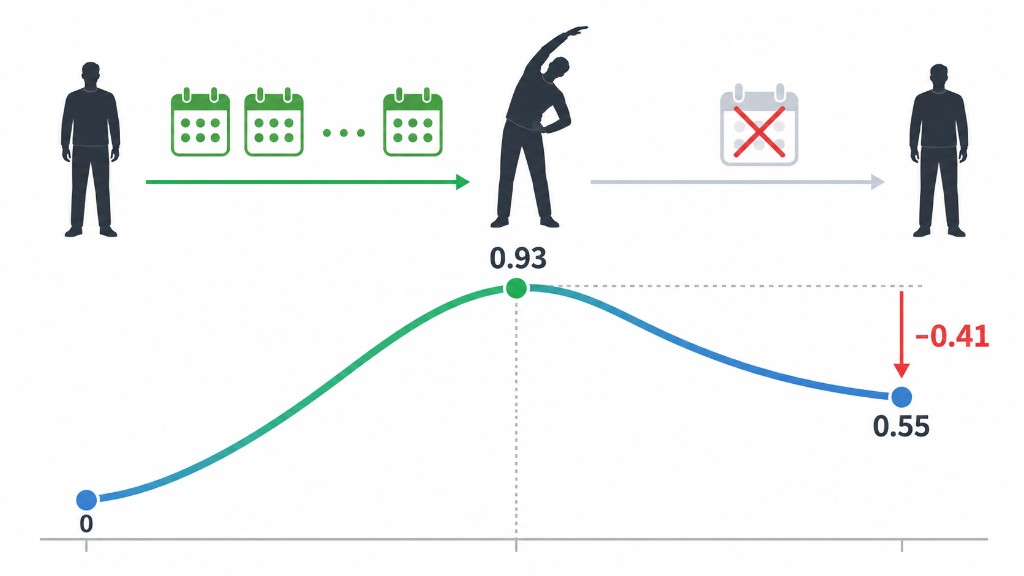
For a reader, that is a more useful picture than “stretch every day or lose everything”: regular practice builds range over time, a short interruption does not necessarily erase all progress, and consistency across months matters more than protecting a perfect seven-day streak.
A practical daily habit can still be valuable because it is easy to remember. But the evidence does not show that seven days per week is a uniquely necessary biological dose.
Sources and further reading
- Ingram et al. — Optimising the Dose of Static Stretching to Improve Flexibility
- Mechanisms Underlying Range of Motion Improvements Following Static Stretching
- Chronic effects of stretching on range of motion: systematic review and meta-analysis
- Habitual physical activity patterns in U.S. adults — NHANES 2003–2006
- Flexibility activities and functional limitation
- Konrad et al. — Detraining effects after chronic stretching training (systematic review and meta-analysis)
Put the guide into practice
Related Flexor routines
These guided routines are linked to the article topic. Review the difficulty and exercise list before starting.
Full-Body Flexibility Builder
A 12-move advanced flexibility practice for spine, hips, hamstrings, and shoulders with dead hang, figure-four, hurdler, puppy pose, and plow.
-

-

-

-
-

- +7
Mobility and Control
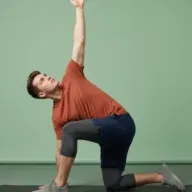
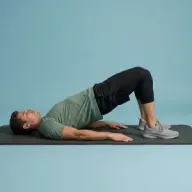
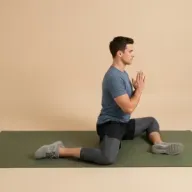
A slow 22-move session for end-range joint control — single-leg stand, dead bug, and 90/90 hip switches build active flexibility.
-
-
-
-

-
- +17
Rise and Shine
A bright morning mobility flow — upward salute, cat-cow, and air squats to wake joints from head to toe.
-

-

-

-

-
- +5