Sitting All Day: What the Numbers Say About Your Back, Neck and Movement
Global inactivity statistics, workplace pain associations and what short movement breaks can realistically do during a sedentary day.

Sitting is part of modern life. Office work, driving, studying, gaming and screen time can keep someone in a chair for hours even if they exercise regularly. The useful question is not whether sitting is “bad posture”. It is how prolonged stillness relates to activity levels, discomfort and health — and what happens when you interrupt it with short bouts of movement.
The global figures below measure missed activity targets, not hours spent in a chair. The two often overlap, but they are not the same thing.
First separate two ideas: inactivity and sedentary time
Physical inactivity means not meeting recommended amounts of moderate- or vigorous-intensity activity. Sedentary behaviour means spending waking time sitting, reclining or otherwise using very little energy. A person can meet the weekly exercise guideline and still sit for much of the working day.
This distinction matters because the global WHO figures below measure physical inactivity, not “hours spent in a chair”. They tell us how much of the population is missing the activity target; they should not be presented as a direct estimate of desk time.
Global physical inactivity: 26% to 31%, with 35% projected
WHO estimates that 31% of adults worldwide — about 1.8 billion people — did not meet recommended physical-activity levels in 2022. That was about five percentage points higher than in 2010, and WHO projects inactivity could reach 35% by 2030 if the trend continues.

The inactivity burden is not evenly distributed
WHO reported that in 2022 about 34% of women and 29% of men globally did not meet activity recommendations, and inactivity tended to be higher in adults over 60. Regional estimates also varied widely: about 48% in high-income Asia Pacific and 45% in South Asia, compared with 28% in high-income Western countries and 14% in Oceania.
These differences are not simply about individual motivation. Transport, work patterns, access to safe spaces, income, culture, disability and public policy all influence how easy it is to accumulate activity.
The relevance to a desk worker is therefore broader than posture: long seated workdays exist inside an overall movement pattern. A two-minute stretch is useful movement, but it is not a substitute for the larger weekly volume of activity associated with health benefits.
Is sitting associated with back and neck pain?
A systematic review and meta-analysis examined musculoskeletal pain and sedentary behaviour. In cross-sectional occupational studies, self-reported workplace sitting was associated with higher odds of both low back pain and neck/shoulder pain.
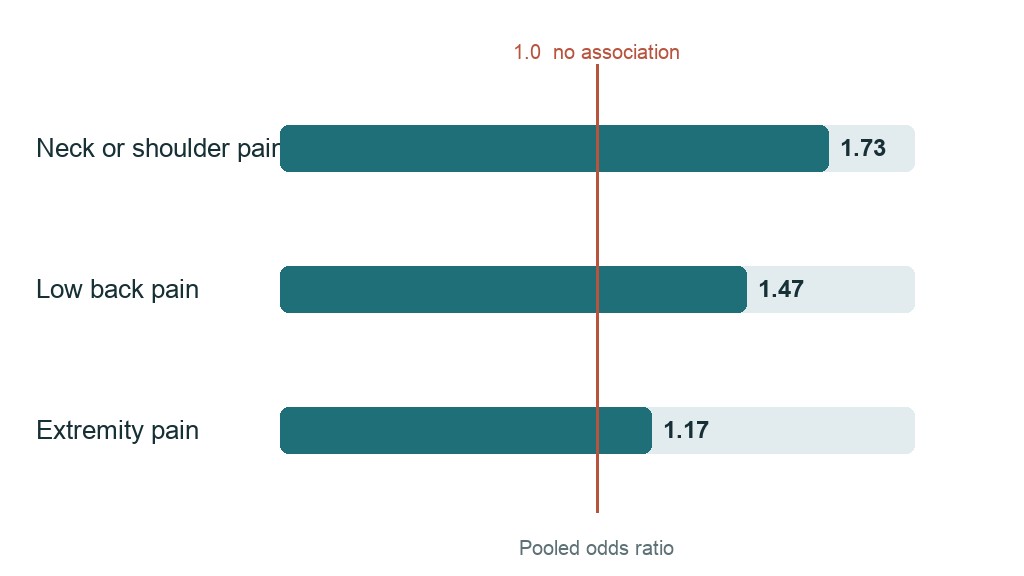
The causal caveat is important. Cross-sectional studies measure exposure and outcome around the same time. Someone may sit more because they already have pain, or a demanding office job may involve stress, limited movement, long screen time and other factors that influence symptoms.
So the evidence does not justify saying a chair is damaging your spine. It does support the practical idea that long periods without changing position can be uncomfortable for many people.
There is no single “perfect posture”
Many desk-health messages focus on finding one ideal sitting position and maintaining it. In real life, even a textbook posture can become uncomfortable if you hold it long enough.
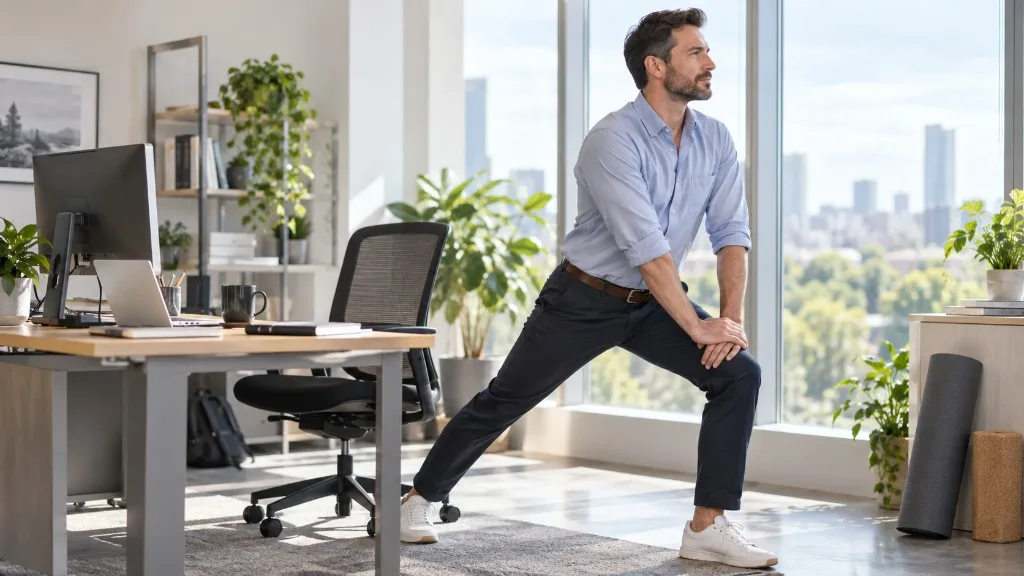
A better target is postural variety: move between upright sitting, supported sitting, standing and walking where practical. Adjust the screen, chair and keyboard so the work is comfortable, but do not turn ergonomics into another demand to remain perfectly still.
What happens when workers take short movement breaks?
A 2026 systematic review examined randomized trials of brief “exercise snacks” used to interrupt prolonged sitting in sedentary workers. It found only six RCTs with 210 participants. The bouts lasted two to ten minutes and included stretching, walking, stair climbing and dynamic muscle contractions. Four trials reported significant improvements in musculoskeletal discomfort.
The important limitation is that five of the six trials were judged at high risk of bias. The evidence is therefore encouraging, not a basis for a universal instruction such as “stretch for exactly two minutes every 30 minutes”.
Older work-break evidence is also cautious. A 2019 Cochrane review of six workplace break-schedule studies involving 373 workers found low-quality evidence that additional breaks alone may make little or no difference to musculoskeletal pain, discomfort or fatigue. Different interventions, populations and break types make the literature difficult to reduce to one timer setting.
Taken together, the evidence supports breaking up long uninterrupted periods with feasible movement, while acknowledging that the best frequency, duration and type of break remain uncertain.
Why a movement break can still be worthwhile
A short break changes more than one exposure at once: it interrupts sitting, changes joint position, contracts muscles, often includes a few steps and gives the eyes and attention a brief change of task. That is why a movement break can be worthwhile even though research has not identified one optimal stretching schedule for desk discomfort.
For this article, the key point is musculoskeletal rather than metabolic: varying position and adding small bouts of movement is more defensible than claiming one perfect posture or one corrective stretch can protect the spine.
What should a desk break actually contain?
There is no need to perform eight stretches every time you stand up. A useful break can combine three elements:
- Change position. Simply stand, walk to another room or refill water.
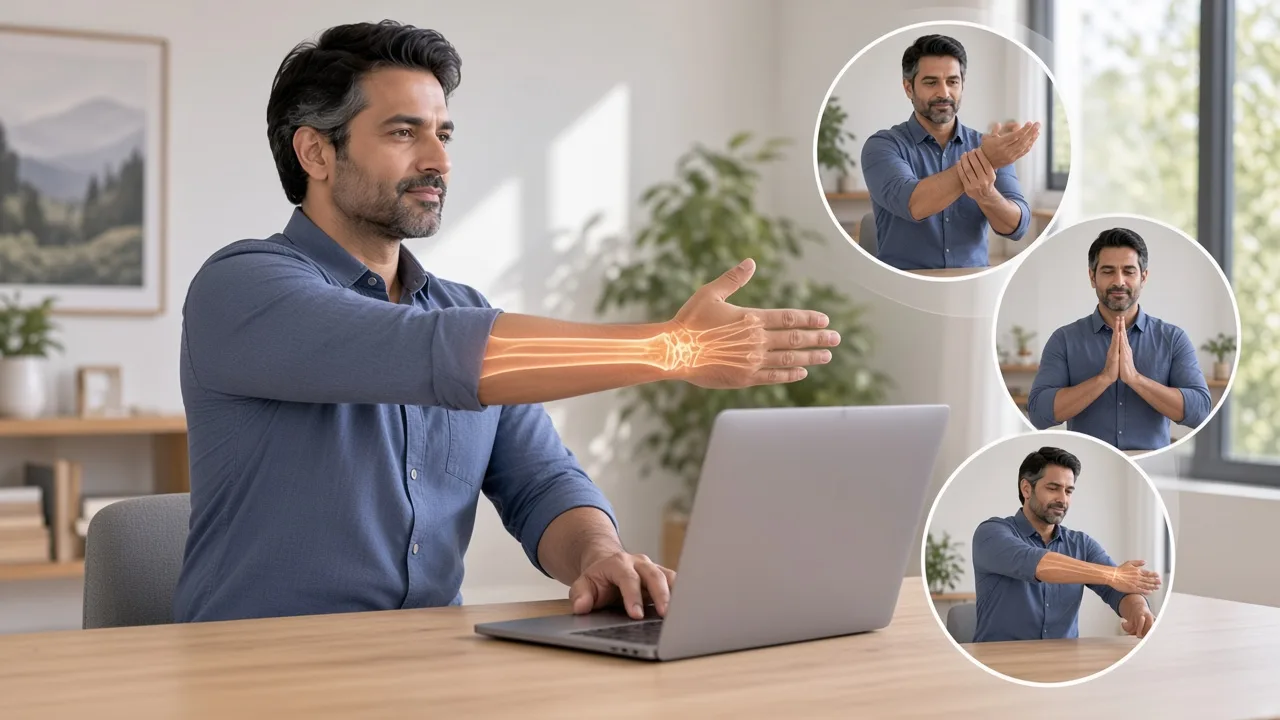
- Move the areas that have been still. Gentle neck rotation, shoulder circles, spinal movement or hip motion can restore variety.
- Add a little load occasionally. A few controlled sit-to-stands, calf raises or wall presses add muscular work that passive stretching does not provide.
Flexor’s Quick Desk Reset, Anti-Sitting Routine and Desk Posture Reset can be used as structured versions of that idea.
How often should you move?
There is no universally proven “stand every 30 minutes” threshold for preventing desk-related pain. Trials have used different schedules, and individual work demands vary. A reminder every 30–60 minutes can be a useful behavioural cue for some people, but it should be presented as a habit strategy rather than a medically established dose.
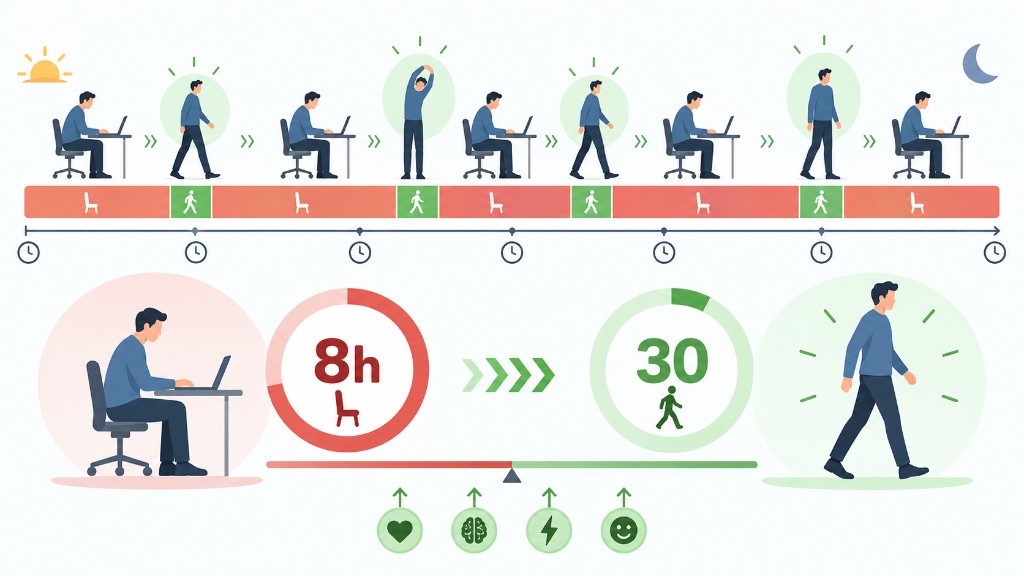
More useful triggers are practical: stand after a meeting, walk when a task does not require typing, change position when discomfort begins to build, or use a brief reset between focused work blocks. The aim is to reduce long uninterrupted periods, not to satisfy a perfect timer.
What sitting does not mean
Feeling tight after sitting does not necessarily mean a muscle has permanently shortened. “Tightness” is a sensation influenced by position, recent activity, stress, fatigue and how much a joint has moved. A few minutes of movement can often change that sensation quickly — too quickly for a major structural change to have occurred.
Why this matters at a population level
The 1.8-billion inactivity figure is bigger than a desk-stretch problem. WHO links insufficient physical activity with increased risk of cardiovascular disease, type 2 diabetes, dementia and several cancers. Short mobility breaks should therefore be seen as one piece of a much larger activity pattern, not as a replacement for walking, sport, resistance training or other moderate-to-vigorous exercise.
A person can use Flexor to reduce long uninterrupted periods of sitting while still aiming for the broader weekly activity recommendations.
What to do with the sitting evidence
Sitting all day is not best understood as a posture emergency. It is a movement-distribution problem. Global physical inactivity is rising, workplace sitting is associated with higher odds of some musculoskeletal pain in cross-sectional research, and emerging randomized trials suggest that very short activity breaks can reduce discomfort for some sedentary workers.
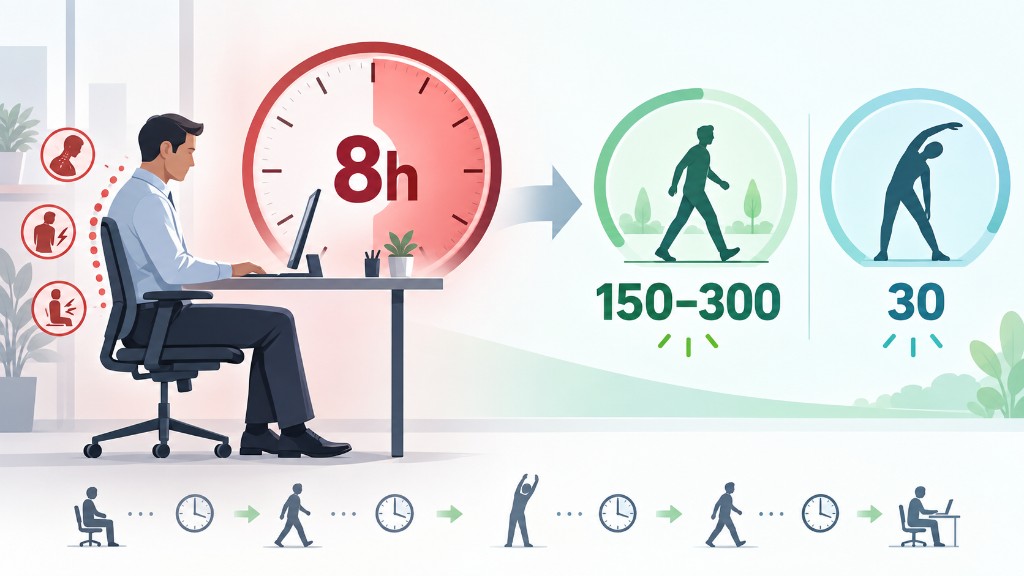
The most defensible advice is also the simplest: do not wait for one perfect stretch to undo eight hours of sitting. Change position and move repeatedly across the day.
Sources and further reading
- World Health Organization — Physical activity fact sheet
- WHO — Nearly 1.8 billion adults at risk from insufficient physical activity
- Sedentary behaviour and musculoskeletal pain — systematic review and meta-analysis
- Brief exercise breaks and musculoskeletal discomfort in sedentary workers — systematic review
- Cochrane review — Work-break schedules for preventing musculoskeletal symptoms in healthy workers
Put the guide into practice
Related Flexor routines
These guided routines are linked to the article topic. Review the difficulty and exercise list before starting.
Quick Desk Reset
A 9-move desk break in under five minutes — chin retractions, hip openers, and seated twist to undo office slump.
-

-

-
-

-

- +4
Anti-Sitting Routine
A 10-move desk-break counterbalance — chin retractions, figure four, and down-dog split reversing hip flexor and spinal strain from sitting.
-

-

-

-

-

- +5
Desk Posture Reset
A desk-worker posture reset — chin retractions, bird dog, doorway pecs, and thread the needle to open the chest and reconnect core support.
-

-

-
-

-
- +9